View source

Splicing (OpenSplice)

Predict signed changes in alternative-exon inclusion for variants in complete three-exon minigene cassettes, using exact construct sequence and assay context.

published exon panels each contain 50 measured alleles. Version-2 panels sample five score-space bins, with sparse-bin slots redistributed. Every prompt uses opaque candidate IDs and excludes source identity, outcomes, selection labels, genomic coordinates, and specialized predictor outputs. The primary score is mean within-exon Spearman correlation; mean Pearson correlation reports numerical agreement, valid-output rate reports strict JSON compliance, and invalid completed outputs contribute zero while remaining identifiable as format failures.

Exons were deliberately selected for large measured 5th-to-95th-percentile effect range, and each panel is sampled across score-space bins. The task emphasizes effect discrimination rather than the natural distribution of exon architectures or effect sizes. Scores describe exon inclusion in a specific HEK293T minigene reporter; they are not direct estimates of native-tissue splicing or clinical pathogenicity.

Source data come from Quarantani et al. (2026) and the OpenSplice Figshare v5 dataset.
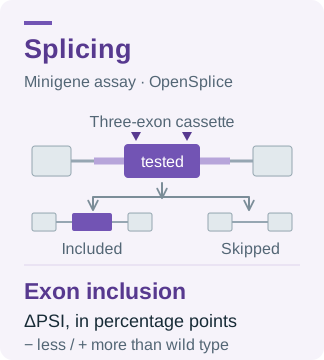
Splicing (OpenSplice): variants in a three-exon cassette can change inclusion or skipping of the middle exon. Predict ΔPSI, the change in exon inclusion relative to the reference.

Questions

Inspect the exact prompt given to a model alongside its complete response.

questions match the current filters · select one row to inspect it