Ocean general circulation models are essential to climate science but computationally expensive,
severely limiting the ensembles and scenarios that can be explored. Neural emulators promise
orders-of-magnitude speedups, yet no ocean emulator to date has combined fine spatial resolution
with multi-year autoregressive rollouts. Samudra, the first autoregressive neural ocean emulator
to produce multi-decade global rollouts, was restricted to 1 deg resolution and exhibited two
long-horizon failure modes: variance collapse and imprinting artifacts.
Samudra 2 extends that framework with two complementary modifications: a widened ConvNeXt U-Net
backbone with a reduced block-internal expansion factor, and a dynamic loss that reweights
per-variable MSE contributions inversely by each channel's running prediction error. This
amplifies the gradient signal from slow-evolving deep-ocean fields that standard MSE would
otherwise neglect.
At 1 deg, Samudra 2 raises upper-ocean global-mean temperature R2 from 0.56 to 0.87
and reduces deep-ocean temperature error by roughly sevenfold compared to the original Samudra.
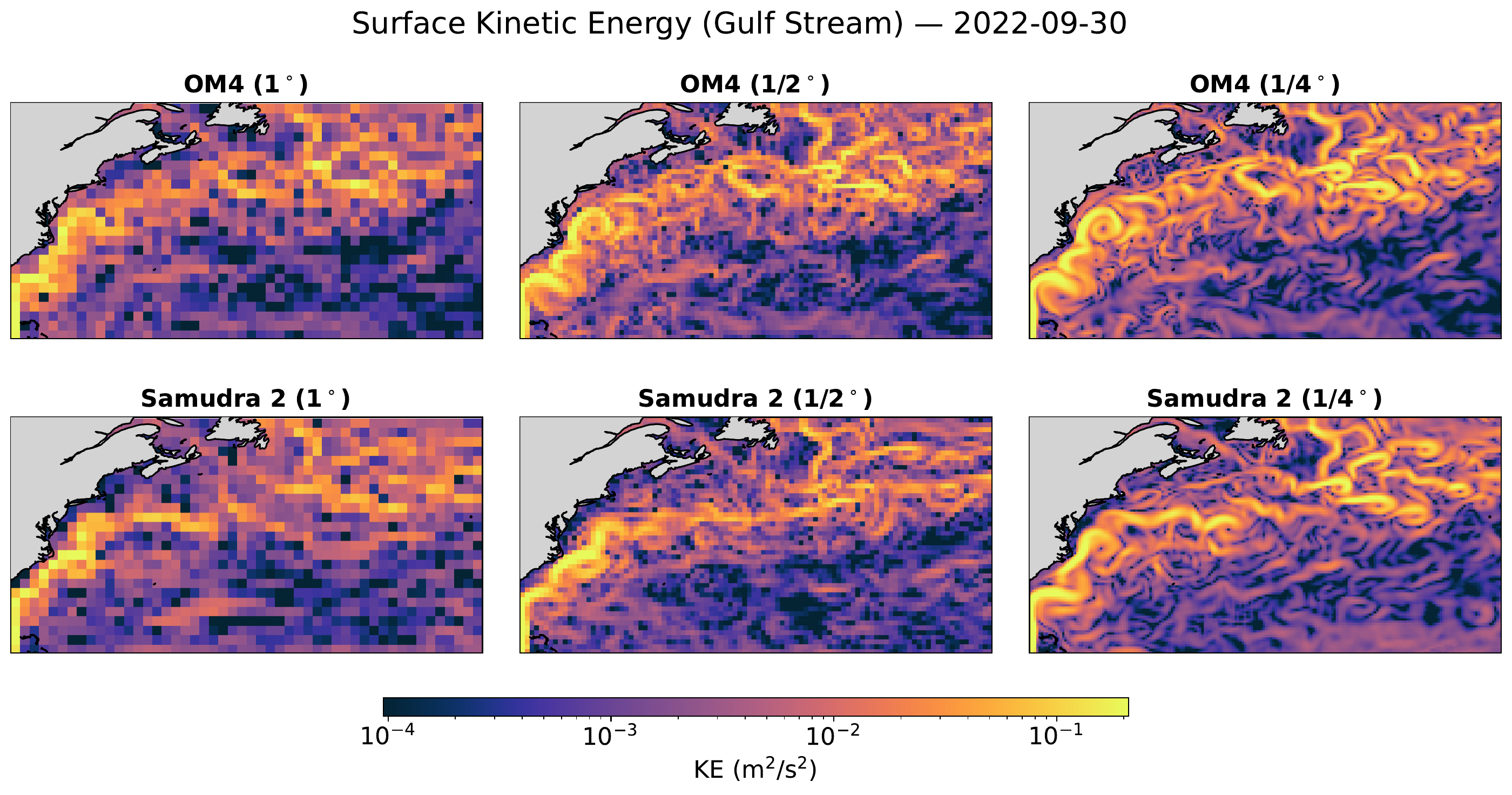
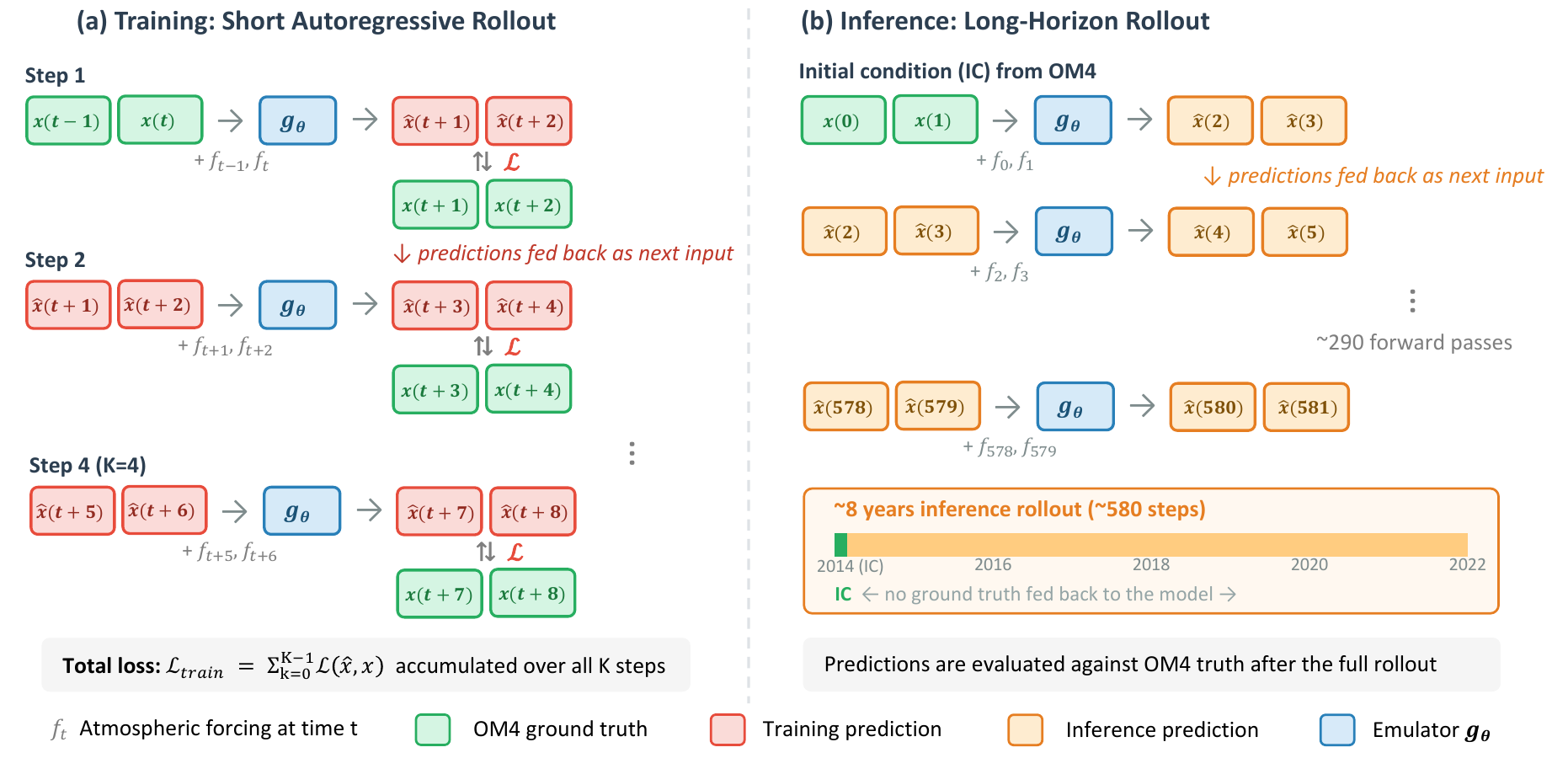
The same architecture scales to 1/2 deg and 1/4 deg over approximately 8-year autoregressive
rollouts, recovering mesoscale eddies and sharp western boundary currents absent at coarser grids.